

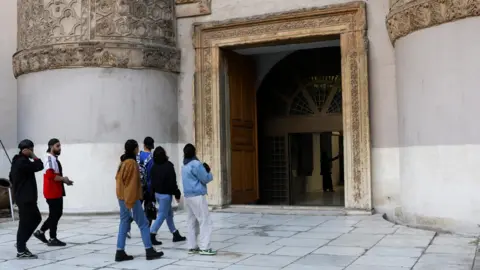
Valuable sculptures and additional items have been stolen from Syria's National Museum in the capital, officials say.
The burglary was noticed on the start of the week, when employees reportedly found that one of the museum's doors had been broken from the inside.
The six stolen statues were made of marble and traced back to the Roman era, one official stated to the news agency.
The nation's antiquities authority said it had opened an investigation to determine the "circumstances surrounding the theft of a group of exhibits", and that measures had been implemented to improve security and monitoring systems.
The director of domestic security in Damascus province, General Osama Atkeh, was quoted by the state-run Sana news agency as saying that authorities were examining the robbery, which he said had affected several "historical artifacts and valuable objects".
He noted that museum protectors at the facility and other individuals were being questioned.
The cultural institution, which was founded in the early twentieth century, holds the primary cultural treasures in the country.
It features ancient inscribed tablets tracing back to the ancient era from Ugarit, where indications of the most ancient complete alphabet was uncovered; Greco-Roman period classical statues from historical site, one of the most important cultural centres of the classical era; and a 3rd Century AD Jewish temple that was constructed at an ancient location.
The institution was forced to close in the early 2010s, a year after the outbreak of the destructive conflict. The majority of the artifacts was removed and preserved at secret locations to protect them.
It began limited operations in recent years and resumed full operations in the beginning of the year, four weeks after rebel forces deposed the Assad regime.
Each of the six of Syria's Unesco World Heritage sites were harmed or partly ruined during the civil war.
The IS organization demolished multiple religious structures and other structures at the ancient city, asserting that they were against their beliefs. Unesco denounced the demolition as a war crime.
Numerous artefacts were also destroyed or taken from dig sites and cultural institutions.


