

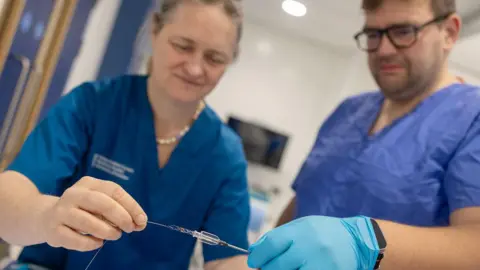
Medical professionals from Scotland and America have accomplished what is considered a historic stroke procedure utilizing automated systems.
The lead surgeon, associated with a medical institution, performed the remote thrombectomy - the extraction of blood clots after a cerebral event - on a donated body that had been contributed to medicine.
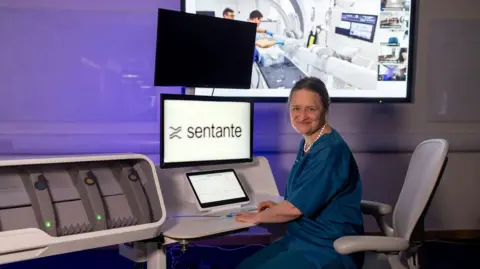
The expert was positioned in a major hospital in the Scottish city, while the subject undergoing procedure while using the system was across the city at the research facility.
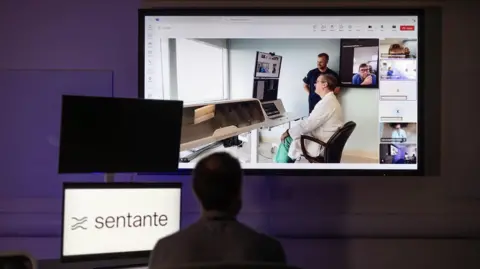
Later that day, a neurosurgeon from Florida used the technology to carry out the initial intercontinental procedure from his Jacksonville base on a donated cadaver in the Scottish city over 4,000 miles away.
The research collective has called it a potential "game changer" if it gains clearance for medical treatment.
The medics believe this technology could change cerebral healthcare, as a delay in accessing professional intervention can have a major influence on the chances of recovery.
"It seemed like we were witnessing the first glimpse of the future," stated Prof Grunwald.
"While in the past this was regarded as science fiction, we showed that every step of the procedure can already be done."
The Scottish institution is the international education hub of the international stroke organization, and is the sole location in the UK where surgeons can work with cadavers with actual blood flowing through the arteries to simulate procedures on a actual patient.
"This represented the pioneering moment that we could conduct the entire surgical process in a actual human specimen to show that each stage of the procedure are achievable," explained the primary researcher.
A healthcare leader, the director of a health foundation, labeled the transatlantic procedure as "a remarkable innovation".
"During many years, individuals from isolated regions have been denied availability to surgical intervention," she added.
"This type of automation could address the disparity which occurs in stroke treatment throughout Britain."
How does the system function?
An brain attack takes place when an artery is blocked by a clot.
This disrupts blood and oxygen supply to the cerebral tissue, and neurons lose function and expire.
The best treatment is a thrombectomy, where a expert uses catheters and wires to clear the obstruction.
But what happens when a individual can't get to a expert who can conduct the operation?
The lead researcher stated the trial showed a robot could be linked with the identical medical instruments a surgeon would normally use, and a medical staff who is with the patient could readily join the instruments.
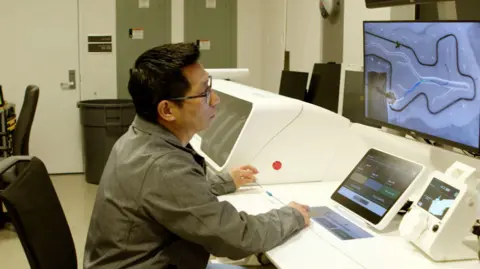
The specialist, in another location, could then manipulate and control their personal instruments, and the automated system then performs comparable motions in live timing on the patient to perform the clot removal.
The individual would be in a treatment center, while the doctor could perform the surgery using the automated equipment from anywhere - even their personal residence.
The medical expert and the American specialist could see real-time imaging of the body in the experiments, and monitor progress in real time, with the Dundee expert saying it took just a brief period of preparation.
Tech giants Nvidia and Ericsson were involved in the initiative to ensure the network connection of the automated system.
"To conduct procedures from the US to Scotland with a brief latency - a blink of an eye - is genuinely extraordinary," stated the neurosurgeon.
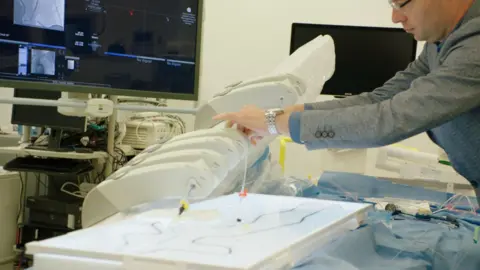
Innovations in cerebral healthcare
The medical expert, who has won an award for her work and is also the senior official of the international medical organization, explained there were key issues with a standard thrombectomy - a global shortage of surgeons who can conduct it, and intervention relies upon your geographical position.
In the region, there are just three locations patients can receive the procedure - three major cities. If you reside elsewhere, you must journey.
"The procedure is extremely time-critical," stated the lead researcher.
"Each six-minute postponement, you have a one percent reduced probability of having a positive result.
"This system would now offer a innovative method where you're not reliant upon where you dwell - preserving the crucial moments where your cerebral matter is deteriorating."
Healthcare information indicated there were {9,625 ischaemic strokes|numerous cerebral events|


